Carbon steel, also called plain-carbon steel, is steel where the main interstitialalloying constituent is carbon. The American Iron and Steel Institute (AISI) defines carbon steel as: "Steel is considered to be carbon steel when no minimum content is specified or required for chromium, cobalt, molybdenum, nickel, niobium, titanium,tungsten, vanadium or zirconium, or any other element to be added to obtain a desired alloying effect; when the specified minimum for copper does not exceed 0.40 percent; or when the maximum content specified for any of the following elements does not exceed the percentages noted: manganese 1.65, silicon 0.60, copper 0.60."[1]
The term "carbon steel" may also be used in reference to steel which is not stainless steel; in this use carbon steel may include alloy steels.
As the carbon content rises, steel has the ability to become harder and stronger throughheat treating, but this also makes it less ductile. Regardless of the heat treatment, a higher carbon content reduces weldability. In carbon steels, the higher carbon content lowers the melting point.[2]Carbon steel, also called plain-carbon steel, is steel where the main interstitialalloying constituent is carbon. The American Iron and Steel Institute (AISI) defines carbon steel as: "Steel is considered to be carbon steel when no minimum content is specified or required for chromium, cobalt, molybdenum, nickel, niobium, titanium,tungsten, vanadium or zirconium, or any other element to be added to obtain a desired alloying effect; when the specified minimum for copper does not exceed 0.40 percent; or when the maximum content specified for any of the following elements does not exceed the percentages noted: manganese 1.65, silicon 0.60, copper 0.60."[1]
The term "carbon steel" may also be used in reference to steel which is not stainless steel; in this use carbon steel may include alloy steels.
As the carbon content rises, steel has the ability to become harder and stronger throughheat treating, but this also makes it less ductile. Regardless of the heat treatment, a higher carbon content reduces weldability. In carbon steels, the higher carbon content lowers the melting point.[2]
[edit]Types
See also: SAE steel grades
Carbon steel is broken down in to four classes based on carbon content:
[edit]Mild and low carbon steel
Mild steel is the most common form of steel because its price is relatively low while it provides material properties that are acceptable for many applications. Low carbon steel contains approximately 0.05–0.15% carbon[1] and mild steel contains 0.16–0.29%[1] carbon; therefore, it is neither brittle nor ductile. Mild steel has a relatively low tensile strength, but it is cheap and malleable; surface hardness can be increased through carburizing.[3]
It is often used when large quantities of steel are needed, for example as structural steel. The density of mild steel is approximately 7.85 g/cm3 (7850 kg/m3 or 0.284 lb/in3)[4] and the Young's modulus is 210,000 MPa (30,000,000 psi).[5]
Low carbon steels suffer from yield-point runout where the material has two yield points. The first yield point (or upper yield point) is higher than the second and the yield drops dramatically after the upper yield point. If a low carbon steel is only stressed to some point between the upper and lower yield point then the surface may develop Lüder bands.[6]
[edit]Higher carbon steels
Carbon steels which can successfully undergo heat-treatment have a carbon content in the range of 0.30–1.70% by weight. Trace impurities of various other elements can have a significant effect on the quality of the resulting steel. Trace amounts of sulfur in particular make the steel red-short. Low alloy carbon steel, such as A36 grade, contains about 0.05% sulfur and melts around 1426–1538 °C (2599–2800 °F).[7] Manganese is often added to improve the hardenability of low carbon steels. These additions turn the material into alow alloy steel by some definitions, but AISI's definition of carbon steel allows up to 1.65% manganese by weight.
- Medium carbon steel
Approximately 0.30–0.59% carbon content.[1] Balances ductility and strength and has good wear resistance; used for large parts, forging and automotive components.[8]
- High carbon steel
Approximately 0.6–0.99% carbon content.[1] Very strong, used for springs and high-strength wires.[9]
- Ultra-high carbon steel
Approximately 1.0–2.0% carbon content.[1] Steels that can be tempered to great hardness. Used for special purposes like (non-industrial-purpose) knives, axles or punches. Most steels with more than 1.2% carbon content are made using powder metallurgy. Note that steel with a carbon content above 2.0% is considered cast iron.
[edit]Heat treatment
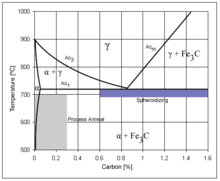
Iron-carbon phase diagram, showing the temperature and carbon ranges for certain types of heat treatments.
Main article: Heat treatment
The purpose of heat treating carbon steel is to change the mechanical properties of steel, usually ductility, hardness, yield strength, or impact resistance. Note that the electrical and thermal conductivity are slightly altered. As with most strengthening techniques for steel,Young's modulus is unaffected. Steel has a higher solid solubility for carbon in the austenitephase; therefore all heat treatments, except spheroidizing and process annealing, start by heating to an austenitic phase. The rate at which the steel is cooled through the eutectoidreaction affects the rate at which carbon diffuses out of austenite. Generally speaking, cooling swiftly will give a finer pearlite (until the martensite critical temperature is reached) and cooling slowly will give a coarser pearlite. Cooling a hypoeutectoid (less than 0.77 wt% C) steel results in a pearlitic structure with α-ferrite at the grain boundaries. If it is hypereutectoid (more than 0.77 wt% C) steel then the structure is full pearlite with small grains of cementite scattered throughout. The relative amounts of constituents are found using the lever rule. Here is a list of the types of heat treatments possible:
- Spheroidizing: Spheroidite forms when carbon steel is heated to approximately 700 °C for over 30 hours. Spheroidite can form at lower temperatures but the time needed drastically increases, as this is a diffusion-controlled process. The result is a structure of rods or spheres of cementite within primary structure (ferrite or pearlite, depending on which side of the eutectoid you are on). The purpose is to soften higher carbon steels and allow more formability. This is the softest and most ductile form of steel. The image to the right shows where spheroidizing usually occurs.[10]
- Full annealing: Carbon steel is heated to approximately 40 °C above Ac3 or Ac1 for 1 hour; this assures all the ferrite transforms into austenite (although cementite might still exist if the carbon content is greater than the eutectoid). The steel must then be cooled slowly, in the realm of 38°C (68.4°F) per hour. Usually it is just furnace cooled, where the furnace is turned off with the steel still inside. This results in a coarse pearlitic structure, which means the "bands" of pearlite are thick. Fully-annealed steel is soft andductile, with no internal stresses, which is often necessary for cost-effective forming. Only spheroidized steel is softer and more ductile.[11]
- Process annealing: A process used to relieve stress in a cold-worked carbon steel with less than 0.3 wt% C. The steel is usually heated up to 550–650 °C for 1 hour, but sometimes temperatures as high as 700 °C. The image rightward shows the area where process annealing occurs.
- Isothermal annealing: It is a process in which hypoeutectoid steel is heated above the upper critical temperature and this temperature is maintained for a time and then the temperature is brought down below lower critical temperature and is again maintained. Then finally it is cooled at room temperature. This method rids any temperature gradient.
- Normalizing: Carbon steel is heated to approximately 55 °C above Ac3 or Acm for 1 hour; this assures the steel completely transforms to austenite. The steel is then air-cooled, which is a cooling rate of approximately 38 °C (68 °F) per minute. This results in a fine pearlitic structure, and a more-uniform structure. Normalized steel has a higher strength than annealed steel; it has a relatively high strength and ductility.[12]
- Quenching: Carbon steel with at least 0.4 wt% C is heated to normalizing temperatures and then rapidly cooled (quenched) in water, brine, or oil to the critical temperature. The critical temperature is dependent on the carbon content, but as a general rule is lower as the carbon content increases. This results in a martensitic structure; a form of steel that possesses a super-saturated carbon content in a deformed body-centered cubic (BCC) crystalline structure, properly termed body-centered tetragonal (BCT), with much internal stress. Thus quenched steel is extremely hard but brittle, usually too brittle for practical purposes. These internal stresses cause stress cracks on the surface. Quenched steel is approximately three to four (with more carbon) fold harder than normalized steel.[13]
- Martempering (Marquenching): Martempering is not actually a tempering procedure, hence the term "marquenching". It is a form of isothermal heat treatment applied after an initial quench of typically in a molten salt bath at a temperature right above the "martensite start temperature". At this temperature, residual stresses within the material are relieved and some bainite may be formed from the retained austenite which did not have time to transform into anything else. In industry, this is a process used to control the ductility and hardness of a material. With longer marquenching, the ductility increases with a minimal loss in strength; the steel is held in this solution until the inner and outer temperatures equalize. Then the steel is cooled at a moderate speed to keep the temperature gradient minimal. Not only does this process reduce internal stresses and stress cracks, but it also increases the impact resistance.[14]
- Quench and tempering: This is the most common heat treatment encountered, because the final properties can be precisely determined by the temperature and time of the tempering. Tempering involves reheating quenched steel to a temperature below theeutectoid temperature then cooling. The elevated temperature allows very small amounts of spheroidite to form, which restores ductility, but reduces hardness. Actual temperatures and times are carefully chosen for each composition.[15]
- Austempering: The austempering process is the same as martempering, except the steel is held in the molten salt bath through the bainite transformation temperatures, and then moderately cooled. The resulting bainite steel has a greater ductility, higher impact resistance, and less distortion. The disadvantage of austempering is it can only be used on a few steels, and it requires a special salt bath.[16]
Carbon steel, also called plain-carbon steel, is steel where the main interstitialalloying constituent is carbon. The American Iron and Steel Institute (AISI) defines carbon steel as: "Steel is considered to be carbon steel when no minimum content is specified or required for chromium, cobalt, molybdenum, nickel, niobium, titanium,tungsten, vanadium or zirconium, or any other element to be added to obtain a desired alloying effect; when the specified minimum for copper does not exceed 0.40 percent; or when the maximum content specified for any of the following elements does not exceed the percentages noted: manganese 1.65, silicon 0.60, copper 0.60."[1]
The term "carbon steel" may also be used in reference to steel which is not stainless steel; in this use carbon steel may include alloy steels.
As the carbon content rises, steel has the ability to become harder and stronger throughheat treating, but this also makes it less ductile. Regardless of the heat treatment, a higher carbon content reduces weldability. In carbon steels, the higher carbon content lowers the melting point.[2]
Contents [hide]- 1 Types
- 1.1 Mild and low carbon steel
- 1.2 Higher carbon steels
- 2 Heat treatment
- 3 Case hardening
- 4 See also
- 5 References
- 6 Bibliography
|
[edit]Types
See also: SAE steel grades
Carbon steel is broken down in to four classes based on carbon content:
[edit]Mild and low carbon steel
Mild steel is the most common form of steel because its price is relatively low while it provides material properties that are acceptable for many applications. Low carbon steel contains approximately 0.05–0.15% carbon[1] and mild steel contains 0.16–0.29%[1] carbon; therefore, it is neither brittle nor ductile. Mild steel has a relatively low tensile strength, but it is cheap and malleable; surface hardness can be increased through carburizing.[3]
It is often used when large quantities of steel are needed, for example as structural steel. The density of mild steel is approximately 7.85 g/cm3 (7850 kg/m3 or 0.284 lb/in3)[4] and the Young's modulus is 210,000 MPa (30,000,000 psi).[5]
Low carbon steels suffer from yield-point runout where the material has two yield points. The first yield point (or upper yield point) is higher than the second and the yield drops dramatically after the upper yield point. If a low carbon steel is only stressed to some point between the upper and lower yield point then the surface may develop Lüder bands.[6]
[edit]Higher carbon steels
Carbon steels which can successfully undergo heat-treatment have a carbon content in the range of 0.30–1.70% by weight. Trace impurities of various other elements can have a significant effect on the quality of the resulting steel. Trace amounts of sulfur in particular make the steel red-short. Low alloy carbon steel, such as A36 grade, contains about 0.05% sulfur and melts around 1426–1538 °C (2599–2800 °F).[7] Manganese is often added to improve the hardenability of low carbon steels. These additions turn the material into alow alloy steel by some definitions, but AISI's definition of carbon steel allows up to 1.65% manganese by weight.
- Medium carbon steel
Approximately 0.30–0.59% carbon content.[1] Balances ductility and strength and has good wear resistance; used for large parts, forging and automotive components.[8]
- High carbon steel
Approximately 0.6–0.99% carbon content.[1] Very strong, used for springs and high-strength wires.[9]
- Ultra-high carbon steel
Approximately 1.0–2.0% carbon content.[1] Steels that can be tempered to great hardness. Used for special purposes like (non-industrial-purpose) knives, axles or punches. Most steels with more than 1.2% carbon content are made using powder metallurgy. Note that steel with a carbon content above 2.0% is considered cast iron.
[edit]Heat treatment
Iron-carbon phase diagram, showing the temperature and carbon ranges for certain types of heat treatments.
Main article: Heat treatment
The purpose of heat treating carbon steel is to change the mechanical properties of steel, usually ductility, hardness, yield strength, or impact resistance. Note that the electrical and thermal conductivity are slightly altered. As with most strengthening techniques for steel,Young's modulus is unaffected. Steel has a higher solid solubility for carbon in the austenitephase; therefore all heat treatments, except spheroidizing and process annealing, start by heating to an austenitic phase. The rate at which the steel is cooled through the eutectoidreaction affects the rate at which carbon diffuses out of austenite. Generally speaking, cooling swiftly will give a finer pearlite (until the martensite critical temperature is reached) and cooling slowly will give a coarser pearlite. Cooling a hypoeutectoid (less than 0.77 wt% C) steel results in a pearlitic structure with α-ferrite at the grain boundaries. If it is hypereutectoid (more than 0.77 wt% C) steel then the structure is full pearlite with small grains of cementite scattered throughout. The relative amounts of constituents are found using the lever rule. Here is a list of the types of heat treatments possible:
- Spheroidizing: Spheroidite forms when carbon steel is heated to approximately 700 °C for over 30 hours. Spheroidite can form at lower temperatures but the time needed drastically increases, as this is a diffusion-controlled process. The result is a structure of rods or spheres of cementite within primary structure (ferrite or pearlite, depending on which side of the eutectoid you are on). The purpose is to soften higher carbon steels and allow more formability. This is the softest and most ductile form of steel. The image to the right shows where spheroidizing usually occurs.[10]
- Full annealing: Carbon steel is heated to approximately 40 °C above Ac3 or Ac1 for 1 hour; this assures all the ferrite transforms into austenite (although cementite might still exist if the carbon content is greater than the eutectoid). The steel must then be cooled slowly, in the realm of 38°C (68.4°F) per hour. Usually it is just furnace cooled, where the furnace is turned off with the steel still inside. This results in a coarse pearlitic structure, which means the "bands" of pearlite are thick. Fully-annealed steel is soft andductile, with no internal stresses, which is often necessary for cost-effective forming. Only spheroidized steel is softer and more ductile.[11]
- Process annealing: A process used to relieve stress in a cold-worked carbon steel with less than 0.3 wt% C. The steel is usually heated up to 550–650 °C for 1 hour, but sometimes temperatures as high as 700 °C. The image rightward shows the area where process annealing occurs.
- Isothermal annealing: It is a process in which hypoeutectoid steel is heated above the upper critical temperature and this temperature is maintained for a time and then the temperature is brought down below lower critical temperature and is again maintained. Then finally it is cooled at room temperature. This method rids any temperature gradient.
- Normalizing: Carbon steel is heated to approximately 55 °C above Ac3 or Acm for 1 hour; this assures the steel completely transforms to austenite. The steel is then air-cooled, which is a cooling rate of approximately 38 °C (68 °F) per minute. This results in a fine pearlitic structure, and a more-uniform structure. Normalized steel has a higher strength than annealed steel; it has a relatively high strength and ductility.[12]
- Quenching: Carbon steel with at least 0.4 wt% C is heated to normalizing temperatures and then rapidly cooled (quenched) in water, brine, or oil to the critical temperature. The critical temperature is dependent on the carbon content, but as a general rule is lower as the carbon content increases. This results in a martensitic structure; a form of steel that possesses a super-saturated carbon content in a deformed body-centered cubic (BCC) crystalline structure, properly termed body-centered tetragonal (BCT), with much internal stress. Thus quenched steel is extremely hard but brittle, usually too brittle for practical purposes. These internal stresses cause stress cracks on the surface. Quenched steel is approximately three to four (with more carbon) fold harder than normalized steel.[13]
- Martempering (Marquenching): Martempering is not actually a tempering procedure, hence the term "marquenching". It is a form of isothermal heat treatment applied after an initial quench of typically in a molten salt bath at a temperature right above the "martensite start temperature". At this temperature, residual stresses within the material are relieved and some bainite may be formed from the retained austenite which did not have time to transform into anything else. In industry, this is a process used to control the ductility and hardness of a material. With longer marquenching, the ductility increases with a minimal loss in strength; the steel is held in this solution until the inner and outer temperatures equalize. Then the steel is cooled at a moderate speed to keep the temperature gradient minimal. Not only does this process reduce internal stresses and stress cracks, but it also increases the impact resistance.[14]
- Quench and tempering: This is the most common heat treatment encountered, because the final properties can be precisely determined by the temperature and time of the tempering. Tempering involves reheating quenched steel to a temperature below theeutectoid temperature then cooling. The elevated temperature allows very small amounts of spheroidite to form, which restores ductility, but reduces hardness. Actual temperatures and times are carefully chosen for each composition.[15]
- Austempering: The austempering process is the same as martempering, except the steel is held in the molten salt bath through the bainite transformation temperatures, and then moderately cooled. The resulting bainite steel has a greater ductility, higher impact resistance, and less distortion. The disadvantage of austempering is it can only be used on a few steels, and it requires a special salt bath.[16]